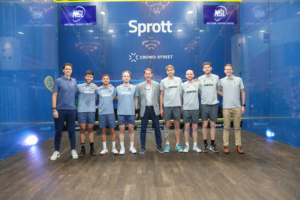
The National Squash League, along with its unique format, is still in its infancy. The NSL has introduced the notion of team squash. The run of play is constricted by time rather than a target point total for an individual player. Teams are also afforded the strategic levers of substitutions and power plays to try to create advantages for their squad.
A somewhat obvious point which we sometimes overlook: the NSL format didn’t come with an instruction manual or a pre-determined set of best practices. Players and coaches are forming those best practices in real time by tinkering with different strategies within the parameters of the NSL rules. This chess match adds a completely new dimension to squash, and deserves to be highlighted on a regular basis.
As such, I’m going to discuss the most innovative strategic moments around the NSL throughout the rest of this season and beyond. By highlighting the players, coaches, and executives who push NSL squash strategy forward, the hope is to document the real-time development of our league.
In this article, we’re going to dive deep into the brilliant coaching of Lucas Piller during the Atlanta Tornados stunning victory over the New York Knights. Even though I’m employed by the NSL, I’m still a fan of the league at heart. I’ve fixated on this match ever since it was played on February 21st. I think this match could be a harbinger for NSL teams’ future strategic planning. Why? Piller and the Atlanta Tornados utilized the NSL’s team aspect better than any team I’ve seen.
As a quick refresher, the lineups for this match:

Conceptualizing Player Roles in NSL Squash
In American team sports, even though players are playing the same sport, their roles can look vastly different. An extreme example would be football, where players are assigned to either play offense or defense. Within offense and defense, there are vastly different skill sets, body types, and tasks that define each position, or role, players are asked to play. A sport like basketball is more fluid, as players are tasked with playing both offense and defense. However, there are well-defined archetypal roles in basketball such as a 3&D wing or a rim protecting big man. Players satisfying these roles aren’t required in order to play basketball. They organically arose through strategic innovation in the game.
NSL squash is a team sport, so you would think that archetypal roles would evolve in our game just as they did in other team sports. This Atlanta vs New York match may have jumpstarted that evolution. For now, I’ve kept the role definitions pretty simple: attacker, defender, and utility player. As you’ll see, Atlanta filled each role perfectly and used each player’s strengths to perfection. Let’s take a close look at the second and third periods of the match to see how Atlanta did so.
Period 2
Atlanta’s strategic genius started in the second period. They trailed 1-0 and needed to adjust their gameplan. Their main adjustment involved putting players in ideal positions to succeed by giving them clearly defined roles. Mohamed Sharaf was the attacker, he’d shorten rallies and go for more drops and kills to put up points quickly. As the attacker, Sharaf was tasked with Atlanta’s power plays too. Ivan Perez was the defender. He used his relentless motor and stamina to elongate rallies, take time off the clock, and limit New York’s scoring opportunities. Miguel Rodriguez, as the star player, served as a utility player. If Atlanta needed him to attack, he could. If Atlanta needed him to defend, he could do that too.
Once Atlanta established these roles, they targeted advantageous matchups on the court which would allow each player to perform their role optimally. Specifically, that meant:
- Always use Mohamed Sharaf (the attacker) on power plays
- Never call a power play against Mohamed ElShorbagy, who defended Atlanta’s Period 1 power play really well.
- Make sure Ivan Perez or Miguel Rodriguez is defending a New York power play.
With those criteria established, Atlanta had the gameplan that would win them the match.
Atlanta began the period starting Sharaf, knowing they’d get a favorable attacking matchup. Sure enough, New York started Rory Stewart. Refer back to the list above. Sharaf is on court, ElShorbagy is off. Power play time. Atlanta wasted no time. After a ninety second warmup. Coach Piller called the power play. Sharaf used the two minute power play to build a 10-1 lead for Atlanta with 16:30 on the clock.
Then, a substitution.
Sharaf was visibly frustrated that he was getting subbed off because he was playing phenomenal attacking squash. But, he’d done his job: build a lead. Now, on came Ivan Perez (the defender) to maintain the lead. Perez settled in nicely, and got the better of Rory Stewart for another five minutes. New York finally pivoted to Mohamed ElShorbagy after the lead ballooned to 16-4 with 11:43 left. For the next five minutes, Perez was matched up with ElShorbagy. Even though Perez is ranked far below him, he more than held his own. Even with a New York power play, Atlanta still led 20-13 with 06:44 on the clock. Why? Because Perez embraced his role as the Tornados’ defensive player.
On the National Squash League Podcast, Perez talked about how the NSL format allowed him to play to his strengths:
“In the NSL, I think the occasion, it was asking me to just defend and keep that lead. I think the NSL format suits me really well in that scenario.”
Mohamed Sharaf could have said the same thing about his attacking play. That’s the beauty of the NSL format. Perez and Sharaf are ranked 57th and 68th in the world as I’m writing. You won’t find them going against the likes of Mohamed ElShorbagy in a PSA tournament. And yet, these two players did the heavy lifting in a win over a New York Knights squad with both ElShorbagy and Eain Yow Ng.
06:44 – Miguel Rodriguez relieved Perez of his defending duties and closed out the period from there. Eain Yow Ng actually brought the Knights back and kept the period close. But, ultimately the lead Sharaf built and Perez maintained was enough to allow Rodriguez to bring it home. Brilliant coaching and playing from Atlanta from start to finish.
Period 3
With two extra substitutions and one extra power play at their disposal, Atlanta had to apply their new successful strategy with some added layers of complexity. Once again, Sharaf started for them against Eain Yow Ng with the same goal in mind: build a lead. Sharaf put in a six minute shift which included Atlanta’s first power play. The result? A 10-3 Atlanta lead with 24:11 on the clock.
Off comes Sharaf. The lead was built, now time for Perez to maintain it against ElShorbagy, who also came on for Ng. Perez initially struggled and allowed ElShorbagy to cut the lead to 11-7. Then, New York called a power play, hoping to take firm control of the third period. That didn’t go to plan. Perez defended the power play flawlessly, and ElShorbagy only managed one point in the whole two minute power play.
With 18:16 left, New York subbed in Rory Stewart to get him his allotted 15 minutes. Atlanta chose to keep Perez on court and ride the hot hand. He didn’t disappoint. Perez thoroughly outclassed Stewart, resulting in a 7-1 run and a 18-9 lead for Atlanta.
Perez turning defense into offense and building a lead was a luxury Atlanta may not have anticipated. This allowed Atlanta to go for the jugular and substitute Sharaf back in the game. With an advantageous matchup against Stewart, Atlanta immediately called their second power play. No messing around. Sharaf ballooned the lead to 23-9, and New York couldn’t sub in Eain Yow Ng fast enough.
Atlanta gave Sharaf a bit more run, but he steadily gave up ground to Ng, who cut the lead to 10 with just under 10 minutes to go. At this point, New York still had one power play left. Atlanta needed to weather the incoming storm and close out the game. Enter their utility player, Miguel Rodriguez.
Rodriguez defended perfectly and took his attacking chances when he could. With five minutes left, New York called their final power play for ElShorbagy as a last ditch effort to cut into a 30-21 deficit. ElShorbagy only managed to score three points. For a moment, it looked like New York might come back. ElShorbagy went on a 7-0 run after the power play was called and Atlanta’s lead was just 30-28. But, Rodriguez’s experience prevailed, as he responded with a 4-0 run of his own to close out the match.
NSL Squash as a True Team Sport
To me, this match illustrated why NSL squash will eventually function as a true team sport.
Atlanta’s brilliant gameplan involved clear and defined roles for each player, and it involved targeting certain matchups to put their players in positions to succeed. Point me to any team sport, basketball, football, hockey, soccer, etc. The meta strategies in all those sports revolve primarily around those principles. The NSL fits right in. Coach Lucas Piller showed the entire NSL world that team sport principles yield success.
I can’t wait to see how teams respond to Atlanta’s innovative strategy. The idea that player rankings aren’t everything is nothing new in the NSL. However, Atlanta took that idea a step further. Not only does good coaching allow your team to be competitive, it can actually give you a substantial edge even with a deficit of talent on paper. That bodes really well for the future of the NSL, and it should incentivize players, coaches, and executives to evolve and innovate, lest they fall too far behind.